Computer Communications

Home / Faculty of Science & Fine Arts / Computer Communications

DEPARTMENT OF COMPUTER SCIENCE

Build the Networks the World Runs On

Every call, stream, and cloud connection depends on networks engineered by people like you. Learn the hardware and software behind global connectivity.

B.S.

Degree Awarded

3 Years

Typical Duration

105

Credit Hours

7+

Career Paths

ABOUT THE PROGRAM

Where Computing Meets Electronics

The Bachelor of Science in Computer Communications blends computer science with electrical engineering — circuits, signals, networking, and embedded systems alongside programming and databases. It's built for students who want to understand not just how software works, but how it physically moves across wires, fiber, and radio waves.

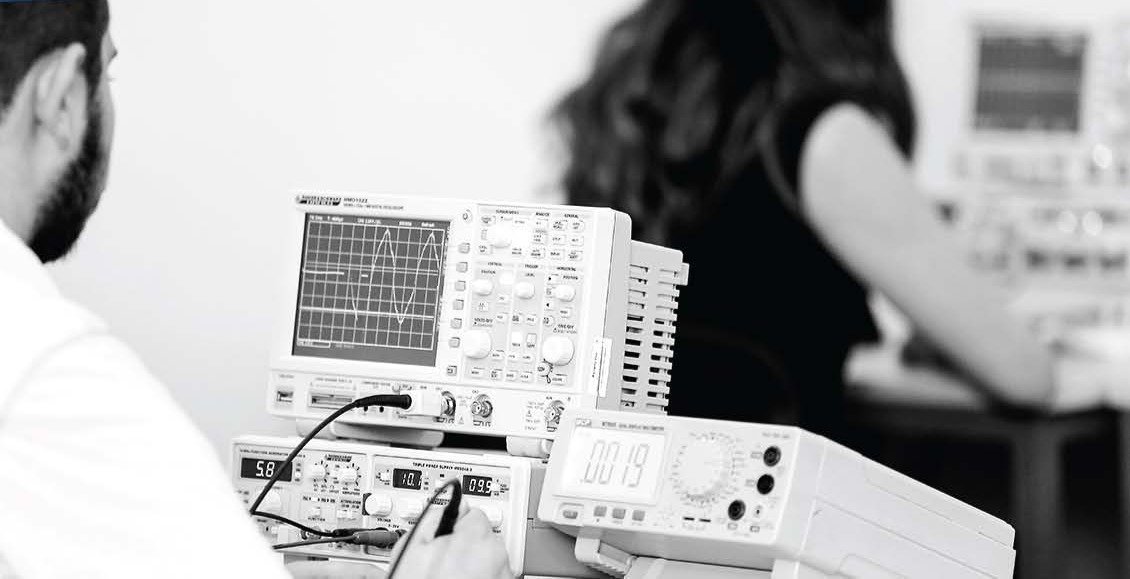
You'll work hands-on with real lab equipment — oscilloscopes, signal generators, routers, and switches — from your very first semesters, building the kind of practical experience network and telecom employers look for.

  • Hybrid computer science + electrical engineering curriculum
  • Hands-on networking & electronics labs
  • Strong foundation for telecom, cloud & cybersecurity careers

Faculty: Faculty of Sciences

Degree: Bachelor of Sciences

Credits: 105 credit

Duration: 3 years

Faculty Email: fsfa@aul.edu.lb

OFFICIAL STUDY PLAN — 105 CREDITS

Curriculum Roadmap

Tap a semester to see the exact courses and credit hours in AUL's official Computer Communications study plan.

1 Semester 1
19 credits

ENG 213 — General English3

ENGR 202 — Introduction to Engineering3

MAT 201 — Calculus III3

MAT 211 — Discrete Math3

CST 201 — General Education I3

CSC 213 / 213L — Programming I + Lab4

2 Semester 2
20 credits

ENG 214 — Academic English3

MAT 220 — Linear Algebra3

MAT 203 — Differential Equations3

CCE 210 / 210L — Logic Design + Lab4

CST 202 — General Education II3

CSC 214 / 214L — Programming II + Lab4

3 Semester 3
20 credits

ENG 216 — Methodology3

PHY 211 — Electricity & Magnetism3

MAT 208 — Probability & Statistics3

CSC 311 / 311L — Data Structures + Lab4

MAT 312 — Engineering Mathematics3

CCE 213 / 213L — Electric Circuits I + Lab4

4 Semester 4
22 credits

MAT 320 — Numerical Computing3

CSC 222 / 222L — Database Systems + Lab4

CCE 338 — Signals and Systems3

CCN 211 / 211L — Networking I + Lab4

CCE 308 / 308L — Machine Architecture & Assembly + Lab4

CCE 214 / 214L — Electronics I + Lab4

5 Semester 5
16 credits

CSC 323 / 323L — Operating Systems + Lab4

CSC 309 / 309L — Web Development + Lab4

CCN 311 / 311L — Networking II + Lab4

MEL — Major Elective4

6 Semester 6 — Senior Year
7 credits

CCN 498 — Senior Project – CC4

FRE — Free Elective3

SKILLS YOU'LL GAIN

Hardware Meets Software

Network Design & Troubleshooting93%
Programming & Systems88%
Electronics & Circuit Design85%
Problem Solving92%
Teamwork & Technical Communication78%
PROGRAM LEARNING OUTCOMES

By Graduation, You Will Be Able To...

1

Design, configure, and troubleshoot computer networks and communication systems.

2

Apply principles of electronics, signals, and systems to communication hardware.

3

Develop software that interacts with networked and embedded systems.

4

Evaluate the security and performance of communication infrastructure.

5

Work effectively in cross-disciplinary teams spanning hardware and software.

CAREER PATHS

Where Graduates Go

Telecom operators, ISPs, cloud providers, and any company that depends on networks.

Network Engineer

Telecom Engineer

Network Security Specialist

Systems Administrator

Cloud Infrastructure Engineer

IoT Engineer

Embedded Systems Developer

IT Consultant

Networking and electronics lab
FACILITIES

Networking & Telecom Lab

From your first electronics lab to your final networking course, you'll work with real routers, switches, signal generators, and oscilloscopes — not just simulations.

  • Routers, switches & structured cabling
  • Oscilloscopes & signal generators
  • Embedded systems & microcontroller kits
  • Open lab hours for senior project work

Ready to Connect the World?

Apply to the Computer Communications program or talk to admissions about your next step.